
Challenge: operator
Goal: Analyze a network packet capture file (pcap), reconstruct a multi-stage payload delivery mechanism, and extract the secret flag.
Flag:
cube{c00l_0p3r4t0rs_us3_mult1_st4g3_p4yl04ds_8ab49338}- written to/tmp/supersecretby the staged receiver
Vulnerability & Network Analysis
Opening the capture file in Wireshark shows traffic between client port 58338 and remote service port 1776:
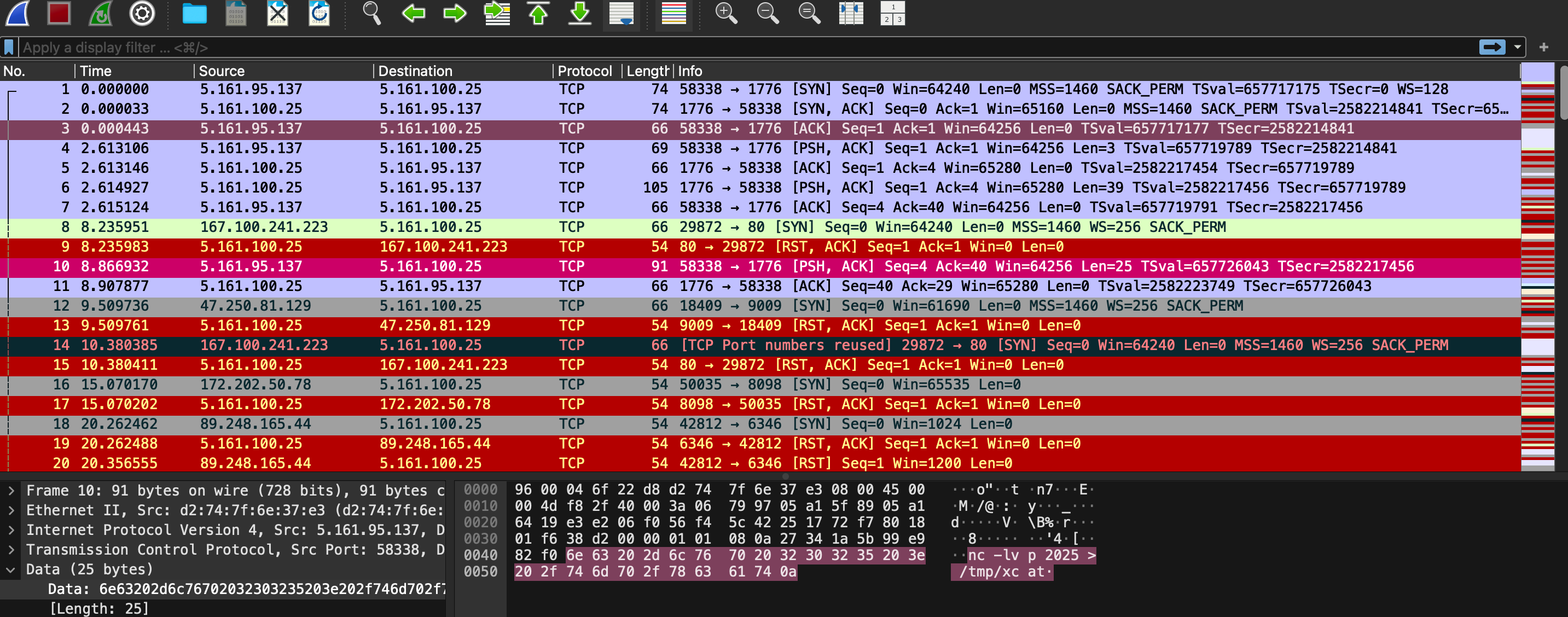
The command channel issues instructions to start a raw TCP listener on port 2025 and redirect incoming output to /tmp/xcat:
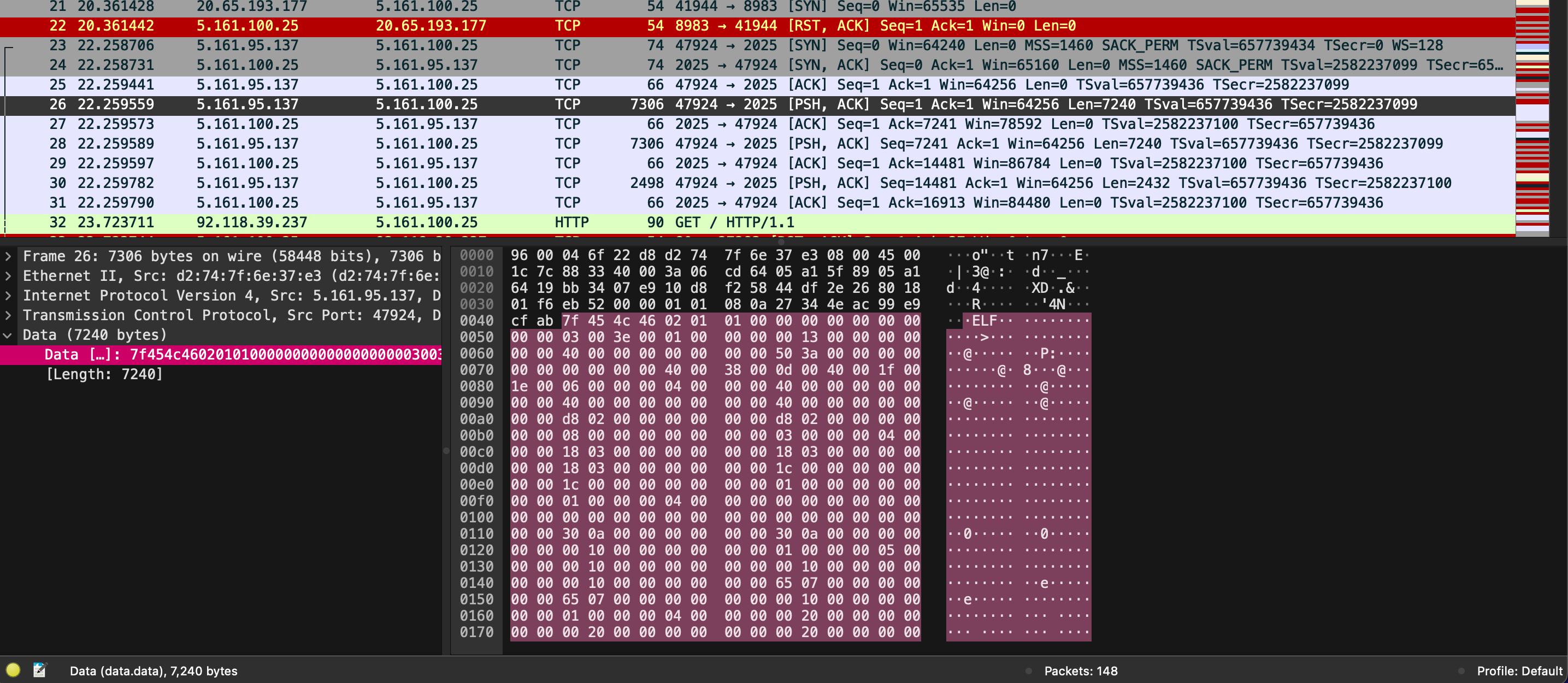
Examining the TCP stream on port 2025, multiple TCP packets with the PSH flag set transmit a full 64-bit ELF binary in raw byte chunks:
Attack Path
1. Extract and Reconstruct the Binary
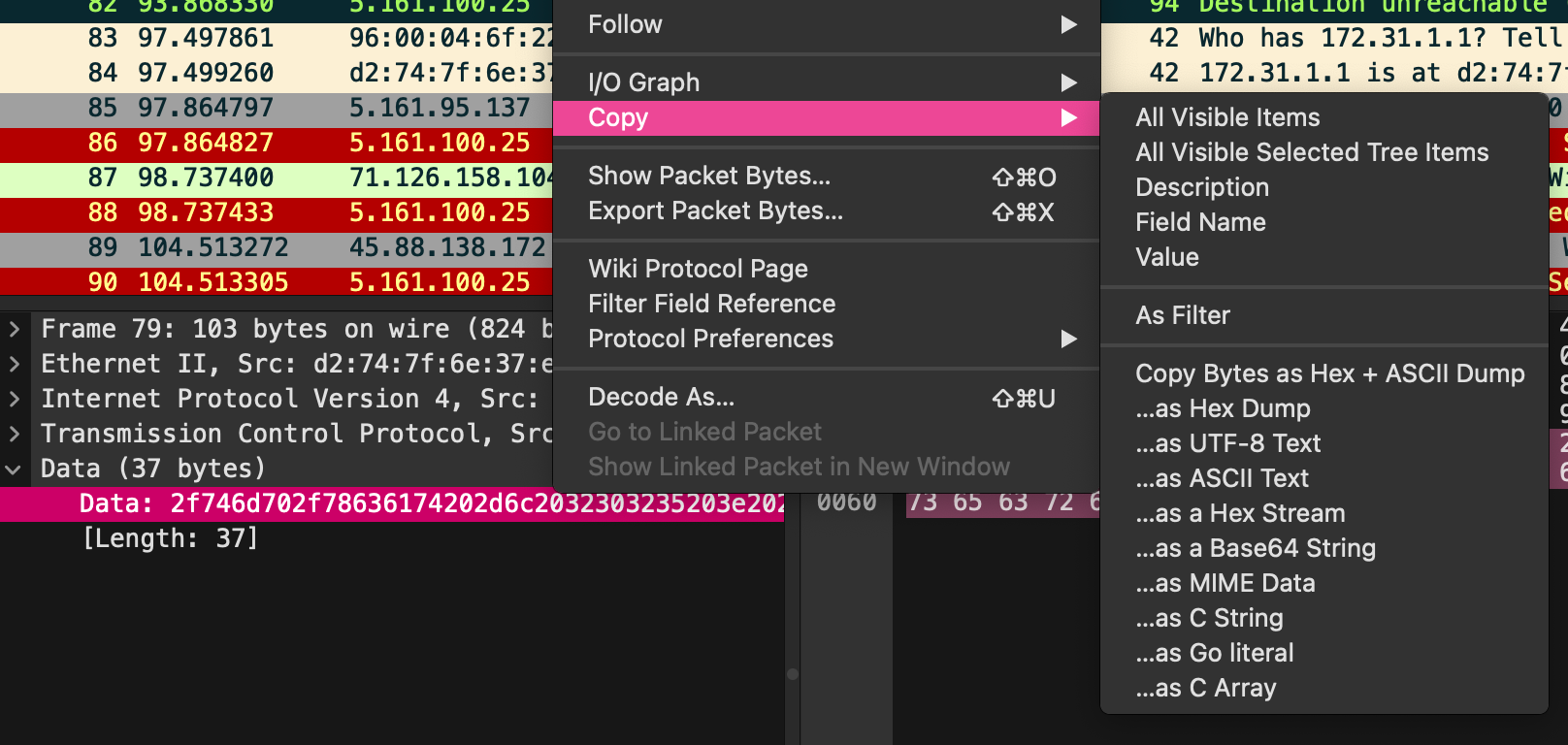
We copy the raw byte streams from the TCP PSH packets (as escaped C string byte sequences) and assemble them using Python:
# Reconstruct ELF executable from packet chunks
with open('final', 'wb') as f:
    f.write(FIRST)
    f.write(SECOND)
    f.write(THIRD)
Running the file command verifies that the file is a valid 64-bit x86_64 ELF shared object:

2. Trace Subsequent Commands
Further down the PCAP stream on port 1776, the operator makes the binary executable and starts it listening on port 2025, piping output into /tmp/supersecret:
chmod +x /tmp/xcat
/tmp/xcat -l 2025 > /tmp/supersecret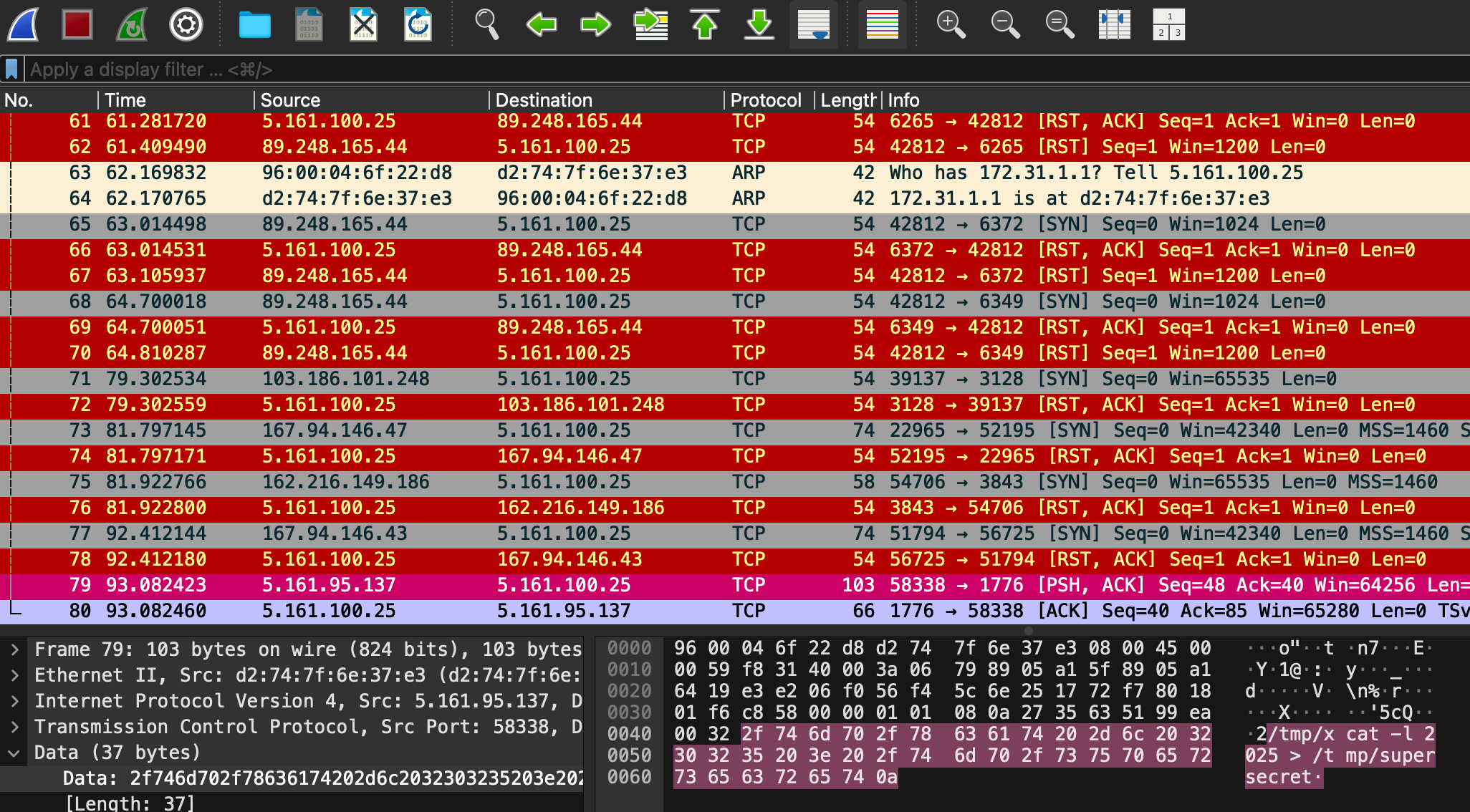
3. Replay Multi-Stage Payload Packets
Subsequent packets in the PCAP show multiple encrypted/packed data blobs being transmitted to port 2025. Using pwntools, we construct a replay script that connects to our local listener and sends the exact sequence of data packets captured in the trace:
from pwn import *

conn = remote("localhost", 2025)

conn.send(b"Ln;V+\x1a\x90\x7f\xb6qP\x02\x7f\xcd\x84\xcbgre\x13b\x05\xd9e\xbb')")
conn.send(b"M'd\x030\x0c\x90c\xb1hF\x02m\x82\xfd")
conn.send(b"\x96\x00\x04o"\xd8\xd2t\x7fn7\xe3\x08\x00E\x00\x00\x81\xdf\\@\x00:\x06\x926\x05\xa1_\x89\x05\xa1d\x19\xd2\xaa\x07\xe99Wv\xa7OOS\x8d\x80\x18\x01\xf6:\xab\x00\x00\x01\x01\x08\x0a'5\xe0\xfb\x99\xeb9\x14Por\x05'I\xd1y\xbb8PMs\x88\xd7\xd8aunV1\x0c\xdex\xb7lJT{\xcd\x99\xc1pbdV1\x06\x90B\xfeoBLj\xcd\x83\xc1$erV1\x1c\xc2n\xfelKGg\xca\x85\xcb$ix\x02b\x0c\xc8{\xb1kFF\x14")
conn.send(b"Ein\x01#\x10\x9c+\xb6}QG9\x9e\xd7\xc3}'c\x192I\xc3n\xbdjFV>\x84\x99\xc8kuz\x176\x00\xdfe\xe4\x12")
conn.send(b"gru\x139\x0a\x80;\xb2G\x13R-\x9f\xc3\xda4ud)7\x1a\x83T\xb3mOV/\xb2\x84\xda0`$)2]\xc9g\xee,GQA\xd5\x96\xcc0>$Ez\x14\xba")
conn.send(b"M'\x7f\x192\x0c\x90e\xb1zLFg\xcd\x91\xc7jcdV6\x01\xd1\x7f\xf06\x0d(")

conn.close()
4. Execute and Read the Flag
We launch the reconstructed xcat listener:
./final -l 2025 > /tmp/supersecretAnd run the Python replay script:


Finally, displaying the contents of /tmp/supersecret:

Flag:
cube{c00l_0p3r4t0rs_us3_mult1_st4g3_p4yl04ds_8ab49338}
Notes
- Multi-stage payload delivery splits malware functionality into initial dropper scripts, intermediate listener binaries, and subsequent data payloads to evade static perimeter defenses.
- Network packet analysis allows complete reconstruction of dropped binaries and captured payload traffic for offline execution and reverse engineering.