Challenge: Incantation
Goal: Reverse engineer a remote cryptographic service to recover the original flag string.
Flag:
cube{4br4c4d4br4_sh3z4m_pr3st0_98f814ff}- reconstructed through synchronized PRNG simulation
Vulnerability
Examining the provided challenge binary in a hex editor reveals that an ELF executable is embedded within the file:
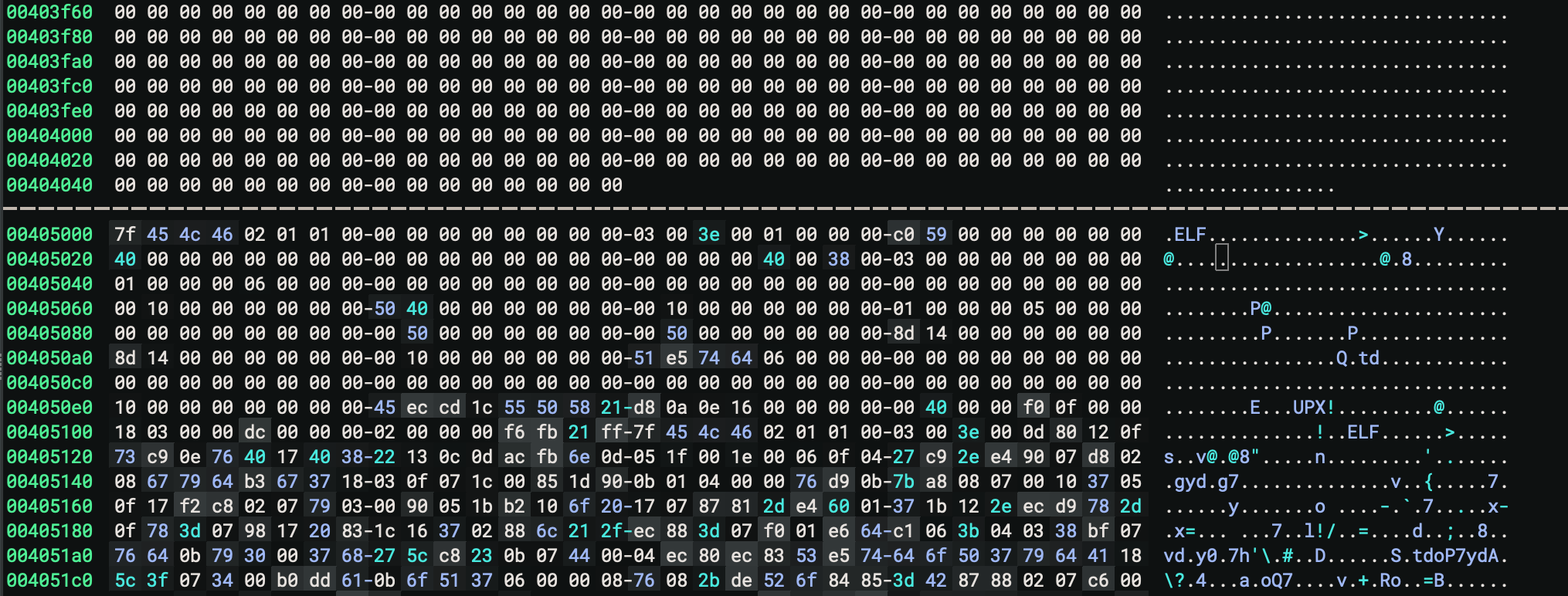
Further inspection reveals the binary was packed with UPX:

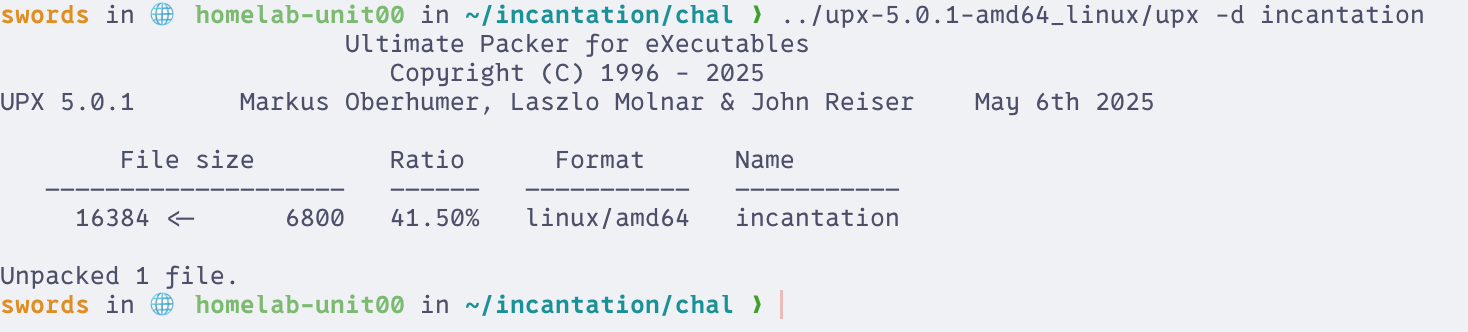
Unpacking the executable using upx -d:
Decompiling the unpacked binary in Ghidra / IDA reveals the encryption mechanism:
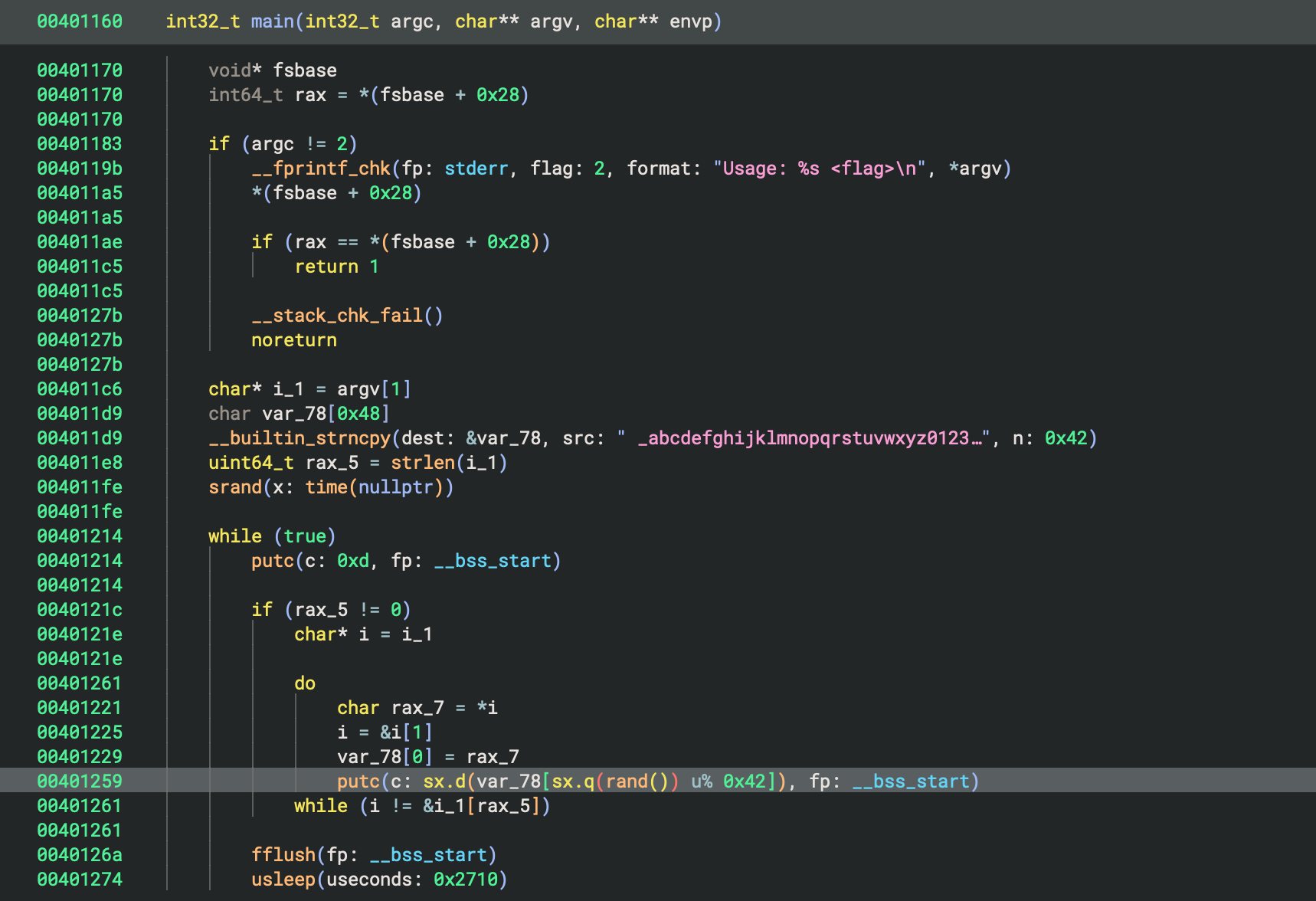
The vulnerability is an insecure pseudo-random number generator (PRNG). The binary initializes the random seed using the current Unix epoch time:
srand(time(NULL));For each round, it computes rand() % 0x42 and uses the result as an index into the string buffer. Because time(NULL) has a low resolution (1-second granularity) and the C standard library’s linear congruential generator (rand()) is completely deterministic given the seed, anyone who knows the server’s approximate time can reproduce the exact same pseudo-random sequence.
Whenever rand() % 0x42 == 0, the output character at position i reveals the -th character of the flag.
Attack Path
1. Prototype Local Solver
Using Python’s ctypes to call the standard C library (libc.so.6), we can seed libc.srand with our local timestamp and simulate the indexing logic:
from pwn import *
from ctypes import CDLL

libc = CDLL('libc.so.6')

p = process(["./incantation", "CTF{test}"])
epoch_time_direct = libc.time(None)
print("Epoch time (direct):", epoch_time_direct)

inp = p.recvall()
l = len(inp)
libc.srand(epoch_time_direct)

known = [None for _ in range(l)]

def found():
    return all(x is not None for x in known)

i = 0
while True:
    if libc.rand() % 0x42 == 0:
        known[i] = inp[i]
        if found():
            break
    i = (i + 1) % l
2. Handle Network Latency on the Remote Target
When targeting the remote challenge server (incantation.chal.cubectf.com:5757), network transmission delay causes a small discrepancy between the client’s local timestamp and the remote server’s time(NULL) timestamp.
To overcome this, we first collect the entire stream of encrypted lines from the server, and then test a window of possible epoch time offsets (range(-200, 200)). Any invalid seed will quickly produce character collisions (inconsistent values at the same index), allowing us to discard wrong seeds immediately and lock onto the true seed:
from pwn import *
from ctypes import CDLL

libc = CDLL('libc.so.6')

p = remote('incantation.chal.cubectf.com', 5757)
epoch_time_direct = libc.time(None)
print("Epoch time (direct):", epoch_time_direct)

inp = p.recvall()
da = inp.split(b"\r")[1:]

def attempt(seed):
    i = 0
    d_i = 0
    current_line = da[d_i]
    l = len(current_line)
    libc.srand(seed)

    known = [None for _ in range(l)]

    def found():
        return all(x is not None for x in known)

    while True:
        if libc.rand() % 0x42 == 0:
            if known[i] is None:
                known[i] = current_line[i]
            else:
                if known[i] != current_line[i]:
                    return False  # Inconsistent character, invalid seed

            if found():
                result = "".join(map(chr, known))
                if result.startswith("cube{"):
                    print("Flag recovered:", result)
                    return True
                else:
                    return False
        i = i + 1

        if i == l:
            i = 0
            d_i += 1
            if d_i >= len(da):
                return False
            current_line = da[d_i]

for offset in range(-200, 200):
    if attempt(epoch_time_direct + offset):
        break
3. Recover the Flag
Executing the solver against the remote server tests the offset window and reconstructs the full flag:

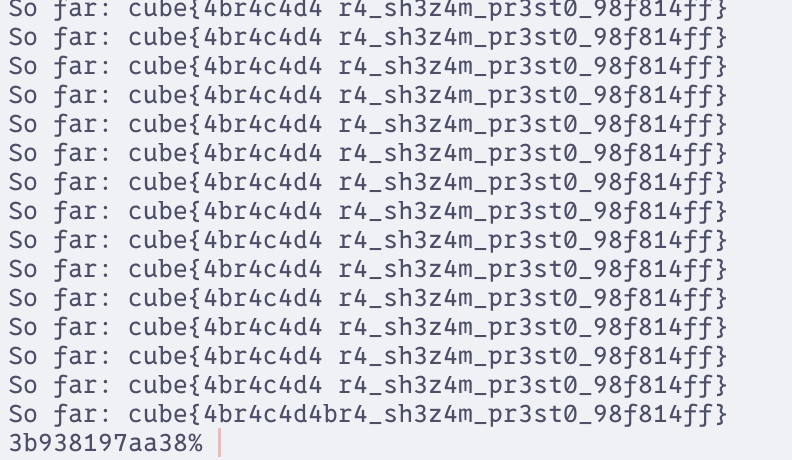
Flag:
cube{4br4c4d4br4_sh3z4m_pr3st0_98f814ff}
Notes
- Never use standard PRNG functions like C’s
rand()or Python’srandomfor security-sensitive operations or cryptographic indexing. - Use cryptographically secure pseudo-random number generators (CSPRNGs) such as
/dev/urandom,getrandom(), orsecretsin Python.